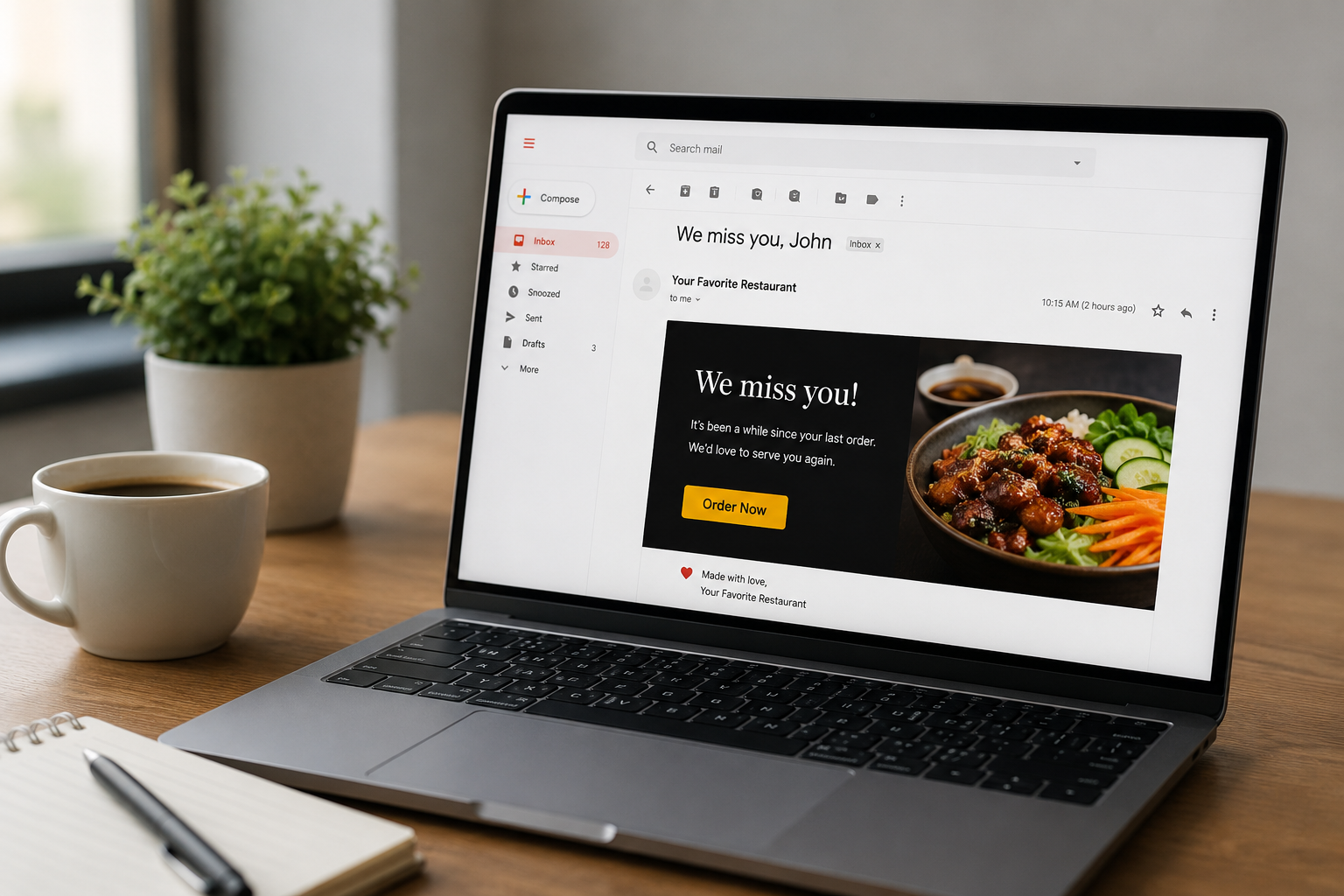
Do you have customers who ordered once and then disappeared?
They liked your food. They used your app. Then they stopped ordering.
Maybe they forgot about your business. Maybe they switched routines. Maybe another app grabbed their attention.
But here’s the good news: email reactivation for delivery businesses is one of the most cost-effective ways to win back inactive customers.
Research from Harvard Business Review shows that keeping existing customers costs less than acquiring new ones.
And email reactivation for delivery businesses is one of the most cost-effective ways to do it!
But there’s a catch: This only works if you own your customer data.
If you rely on third-party apps, the platform owns the customer relationship.
Direct communication becomes difficult. Building your own audience is almost impossible.
On the other hand, when you run your own branded delivery system, you own all that information, which means you basically own the relationship.
That changes everything.
What Is Email Reactivation for Delivery Businesses?
An email reactivation campaign is a series of emails sent to inactive customers.
These are customers who have not ordered in 30, 60, or 90 days.
The email reactivation campaign has 3 simple goals:
- remind them you exist,
- give them a reason to come back,
- and make it easy to order again.
According to HubSpot email marketing statistics, email marketing continues to deliver one of the highest returns on investment in digital marketing.
In other words, email remains one of the most effective ways to bring customers back.
Email Reactivation Campaign Example for Delivery Businesses
Email 1: The Soft Reminder (Day 1)
Subject: We miss you, [Name]
- Keep the message personal and friendly.
- Remind customers what they enjoyed about your business.
- At this stage, avoid aggressive sales language.
Email 2 — The Offer (Day 4)
Subject: Here’s 15% off your next order
- Give customers a reason to come back.
- A discount, free delivery, or bonus item can help drive action.
- For example, many delivery businesses offer free delivery for returning customers.
Email 3 — The Last Chance (Day 7)
Subject: Your offer expires tomorrow
- Create urgency with a clear deadline.
- If customers still do not engage, move them to a lower-frequency email list.
- This way, you avoid overwhelming inactive subscribers with unnecessary emails.
What Makes Email Reactivation Work
- Segment by inactivity window.
- First, segment customers by inactivity period. Someone inactive for 30 days needs a different message than someone gone for 6 months.
- Personalize the subject line.
- Next, personalize your subject lines. Adding a first name or past order reference can improve open rates. Personalized emails perform much better than generic campaigns.
- Make it one-click to reorder.
- Finally, make reordering simple. Too many steps reduce conversions. Link customers directly to their previous order or a pre-filled cart.
Why Delivery Businesses Need Customer Ownership
Email reactivation for delivery businesses only works when you control the customer journey end to end.
That means owning your platform, your data, and your communication channels.
As third-party cookies disappear, companies are investing heavily in first-party customer relationships.
Think with Google’s first-party data strategy guide highlights why businesses that own their customer data gain a long-term competitive advantage.
With Zeew, you get a fully branded delivery system: No commissions, no middlemen, and direct access to your customer base.
Ready to own your customer relationships?
To learn more or build your own delivery platform, visit: https://zeew.eu/